
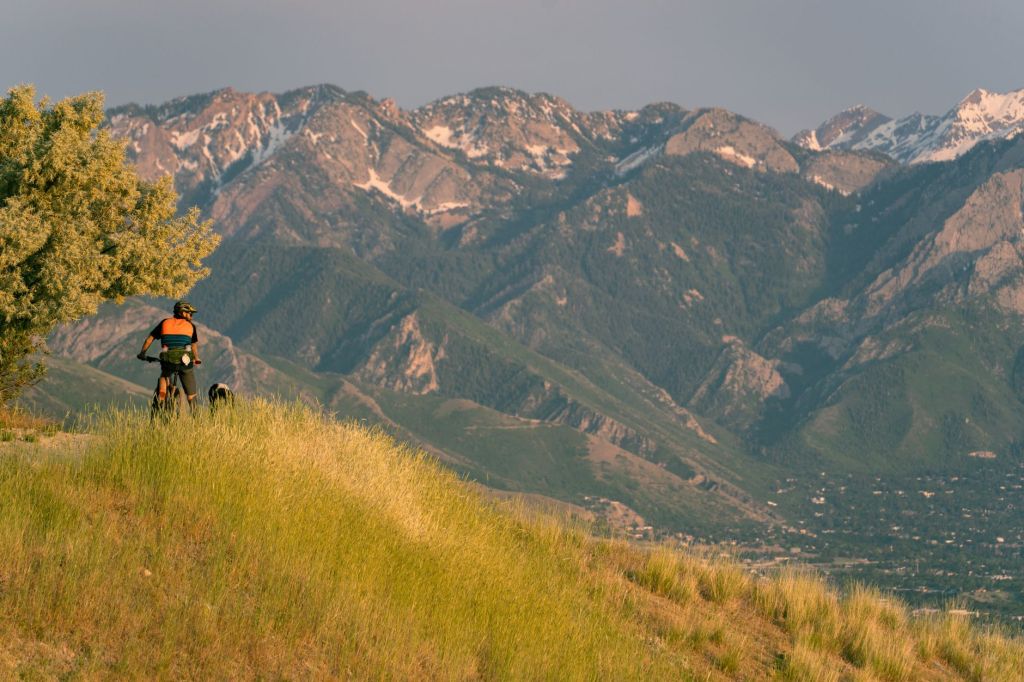
Your body is a temple entrusted to you by God (CCC 364, Romans 12:1, RSV-CE), and every ride is one more way you show up for the people counting on you. Saint Paul used athletic language on purpose when he described discipline: “Every athlete exercises self-control in all things… I pommel my body and subdue it” (1 Corinthians 9:25 to 27, RSV-CE). A bike, whether it is out on the road or set up in your garage, gives you thirty straight minutes where the phone stays in your pocket and your legs do the talking. Three tracks are waiting below, each in a 15, 20, or 30 minute version, built for a road or mountain bike outdoors, or a stationary bike indoors, with ways to fold prayer into every one of them. Get in the saddle. Let’s go.
Jump to: Read this first | Is biking right for you today | Equipment and space | Track 1: Foundation | Track 2: Cadence Intervals | Track 3: Hills and Resistance | Praying while you ride
Disclaimer: Read Before You Start
This is general fitness education, not personalized medical advice, and it does not replace a conversation with your physician.
Talk to your doctor first if: you have not exercised regularly in months, you are over 40 without a recent physical, you are significantly overweight, you have any heart, lung, joint, or chronic condition, or you notice any new symptom you cannot explain.
Stop immediately and seek medical attention for: chest pain or pressure, severe shortness of breath, dizziness or fainting, an irregular or racing heartbeat, or sudden or worsening pain.
These are general starting points for men at or below an average fitness baseline, not an individualized prescription. When in doubt, ease off, lower the resistance, and check with your doctor.
Is Biking Right for You Today
Cycling is a versatile, low-impact activity that can be done outdoors or indoors, in a city or out on a rural road (ISSA CPT Textbook, p.399), which makes it one of the gentler ways to build cardiovascular fitness on your joints. Still, take five minutes to check where you are starting from before picking a track.
- Resting heart rate. Sit quietly for two minutes. Then, using two fingers (not your thumb) on your wrist or the side of your neck, count your pulse for 30 seconds and multiply by two. A resting heart rate between 60 and 100 beats per minute is typical for most men, with well-conditioned men often at the lower end of that range.
- Balance and control check. Can you mount, ride, and dismount a bicycle, or safely get on and off a stationary bike, without wobbling or needing to grab something for support? If you have not ridden in years, practice mounting and dismounting in a flat, empty parking lot, or on a stationary bike, before attempting Track 1 outdoors.
- Outdoor or indoor. If you do not own a bike, do not have a safe place to ride, or the weather where you are will not cooperate, the stationary bike option built into every track below is a full substitute, not a lesser one. Choose whichever gets you moving three times a week.
If your balance is unsteady, your joints flare up, or anything above gives you pause, that is worth a conversation with your doctor before you begin, per the disclaimer above.
Equipment and Space
Outdoor riding. A road bike, with thinner tires, is the more efficient choice on pavement; a mountain bike, with thicker, rugged tires, grips loose or uneven trail surfaces better (ISSA CPT Textbook, p.399). Either works for the tracks below. A properly fitted helmet is not optional. Check tire pressure and brakes before every ride, and choose routes with good sightlines, a shoulder or bike lane, and, if possible, a route a family member knows in advance.
The stationary bike alternative. If you are training indoors on an upright stationary bike, adjust the saddle to hip height so that when a pedal is at the bottom of its rotation, your extended leg keeps a slight bend in the knee, and set the handlebars far enough away to allow a slight bend in your elbows (ISSA CPT Textbook, p.400, Table 11.8). If you are using a recumbent stationary bike instead, adjust the seat so the extended leg still keeps that same slight knee bend; a recumbent’s back support tends to make it the better pick for men managing lower back issues, while an upright tends to be the better pick for men managing knee pain, since a recumbent places more strain on the legs and knees (ISSA CPT Textbook, p.400). Whichever machine you use, get the fit right before your first session. It is worth the extra five minutes, and it is a genuinely equal way to run every track below, not a fallback.
Where to ride outdoors: a paved multi-use trail, a quiet neighborhood loop, or a local park road closed to through traffic all work well for these tracks. Avoid busy arterial roads without a dedicated bike lane, especially for Track 1.
How to Read These Programs
Same two tools as the Cardio Starting Programs and Jump Rope Starting Programs pages: the Talk Test and RPE, a 0 to 10 effort scale. “Easy” is about a 2, full sentences, no strain. “Moderate” is a 3 to 4, you can still talk but it takes effort. “Hard” is a 5 or higher, only a few words at a time. On a bike, resistance or a hill raises your RPE just as much as speed does, so judge effort, not how fast your legs are spinning.
Why cadence matters on a bike (tap to expand)
Cadence is the rhythm at which your pedal strokes turn over, and it changes which muscles do the work. Research cited in ISSA’s own training material found that higher pedaling speeds increase hamstring activation, while slower, harder pedal strokes engage the quadriceps more (ISSA CPT Textbook, p.399). Track 2 below uses that difference on purpose, alternating a quick, light cadence with a slower, heavier one, so you are training more than one muscle group in a single session instead of sitting in one gear the whole way.
The Three Tracks
Each track has a 15, 20, and 30 minute column. Every track works the same way whether you are outdoors or on a stationary bike; the outdoor and indoor notes under each track tell you how to translate the effort.
Track 1: Foundation
Continuous, steady riding at an even effort. The goal is time in the saddle and a comfortable cadence, nothing more.
| Segment | 15 min | 20 min | 30 min |
|---|---|---|---|
| Warm-up (easy spin) | 3 min | 4 min | 5 min |
| Steady ride (RPE 3 to 4) | 9 min | 12 min | 20 min |
| Cool-down (easy spin) | 3 min | 4 min | 5 min |
Outdoor: flat or gently rolling terrain, a gear you can hold for the full steady segment without straining. Indoor: low to moderate resistance on an upright or recumbent stationary bike, per the setup notes above.
Track 2: Cadence Intervals
Alternating a fast, light cadence with a slower, harder one, putting the hamstring and quadriceps research above to work in a single ride.
| Segment | 15 min | 20 min | 30 min |
|---|---|---|---|
| Warm-up (easy spin) | 3 min | 4 min | 5 min |
| Cadence intervals | Fast/light 1.5 min, slow/heavy 1.5 min, x3 (9 min) | Fast/light 1.5 min, slow/heavy 1.5 min, x4 (12 min) | Fast/light 2 min, slow/heavy 2 min, x5 (20 min) |
| Cool-down (easy spin) | 3 min | 4 min | 5 min |
Outdoor: shift to a lighter gear and pedal quickly for the fast segments (RPE 5 to 6), then shift heavier and slow your cadence for the slow segments (RPE 5 to 6 at a different muscle group). Indoor: lower the resistance and increase cadence for the fast segments, then raise resistance and slow your cadence for the slow segments.
Track 3: Hills and Resistance
Building the ability to push through a longer, harder effort, the way a real hill or headwind demands.
| Segment | 15 min | 20 min | 30 min |
|---|---|---|---|
| Warm-up (easy spin) | 3 min | 4 min | 5 min |
| Hill/resistance efforts | Hard 2 min / easy 2 min, x2 (8 min) | Hard 2 min / easy 2 min, x3 (12 min) | Hard 3 min / easy 2 min, x4 (20 min) |
| Cool-down (easy spin) | 4 min | 4 min | 5 min |
Outdoor: find a route with a real incline, or ride into a headwind for the hard segments; terrain and weather both genuinely change the effort a ride demands (ISSA CPT Textbook, p.399). Indoor: raise resistance substantially for the hard segments and drop it back down for recovery.
After the first two to three weeks: once a session in a track stops feeling challenging, increase total time by about 10 percent before increasing intensity, the same progression rule used on the Cardio Starting Programs and Jump Rope Starting Programs pages (ISSA CPT Textbook, p.372). Only change one variable at a time, either the time or the resistance/hill difficulty, not both in the same week. If a week feels too hard, repeat it.
Praying While You Ride: Best Practices
The Church defines prayer as “the raising of one’s mind and heart to God” (CCC 2559), and vocal prayer, meditation, and contemplative prayer are all legitimate, Church affirmed expressions of it (CCC 2700 to 2719). A bike ride gives you a long, steady rhythm, closer to a walk or a run than to jump rope’s short bursts, which makes it a natural setting for sustained prayer.
| Track | Suggested prayer method |
|---|---|
| Foundation | A full Rosary fits comfortably inside the 20 or 30 minute steady ride |
| Cadence Intervals | Breath prayer during the fast segments, a Hail Mary or two during the slow segments |
| Hills and Resistance | Offer each hard effort for a specific intention; breath prayer or a decade during recovery |
Two ways to pray in the saddle (tap to expand)
Riding the Rosary. The steady, repetitive motion of a long ride pairs naturally with the repeated Hail Marys of the Rosary. A full five decade Rosary takes about 20 minutes, so it fits neatly inside Track 1’s longer sessions.
Offering the climb. During the hardest efforts in Track 3, when a hill or a headwind makes conversation impossible anyway, unite that effort to Christ rather than just grinding through it, the traditional practice of “offering it up” (CCC 618). Saint Paul’s image of an athlete’s self-discipline, so as not to be disqualified (1 Corinthians 9:27), fits a hard climb as naturally as it fits a sprint.
If a specific practice raises a question, that is worth a quick conversation with your parish priest rather than guesswork.
This is fitness for the sake of your family and your prayer life, not the mirror. Get in the saddle, outdoors or in the garage, pick the track that fits where you are today, and ride.
Sources and citations
Cycling variables (tire type, frame weight, cadence and muscle activation, environment, and terrain), the muscles engaged in cycling, and upright versus recumbent stationary bike setup and fit guidance drawn directly from ISSA (International Sports Sciences Association) Foundations and Applications for a Certified Personal Trainer, 10th Edition (2021), p.399 (Cycling section) and p.400 (Table 11.8, Upright and Recumbent Bike Setup Procedures). The 10 percent progression rule per the same text, p.372, consistent with the sourcing on the existing Cardio Starting Programs and Jump Rope Starting Programs pages. FITT-VP framework and RPE/Talk Test intensity anchoring per ISSA Chapters 9 and 11. Doctrinal claims tied to CCC 364, 618, 2559, and 2700 to 2719. Scripture citations from the RSV-CE (Romans 12:1, 1 Corinthians 9:24 to 27). This page is general fitness education, not medical advice; please confirm any prayer practice question with a priest, and any health question with a physician, before relying on this page alone.
Download the Bike Workout Planner (PDF). It is also available, along with the other two planners, on the Resources page.
 Run and Pray Movement